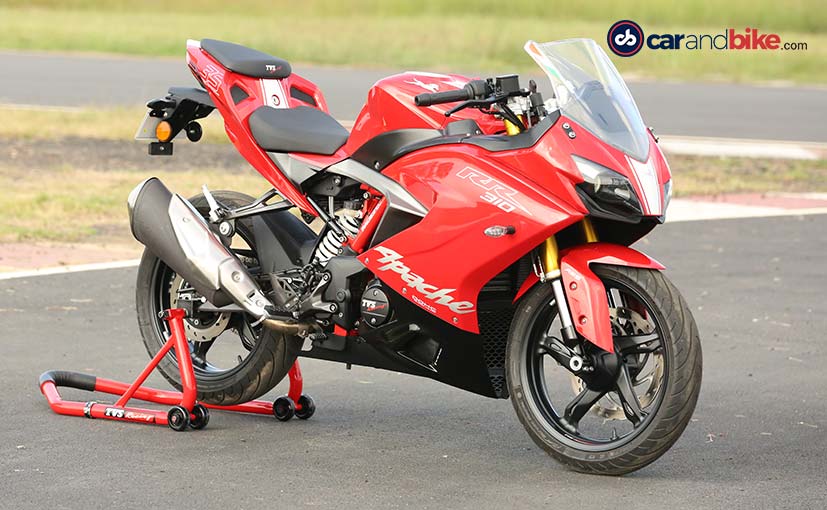
If you have ever raced a motorcycle, you will know that it comes with a massive takeaway of learning, regardless of where you finish. Now, imagine what thirty-five years of racing can teach you. TVS has been racing for exactly that many years and it believes the culmination of it all is this new motorcycle you see here – the Apache RR 310.
So, it’s a faired BMW G 310 R, then?
At a very basal level, yes, it is; but it would be incorrect (or unfair?) to call it that, truthfully. It’s true that BMW was the first to build and launch a motorcycle around this co-developed 312.2cc engine but TVS picked up on the project and added its own learning and expertise, to the mix. TVS’ involvement with further developing this setup – specifically for the RR 310, that is – has not been limited to just the visual package but also includes significant India-specific advancements to the engine, as well as the chassis. The end-result is a motorcycle which is BMW-enough (read premium, European) in most aspects – and yet characteristically TVS, overall.
At a very basal level, yes, it is; but it would be incorrect (or unfair?) to call it that, truthfully. It’s true that BMW was the first to build and launch a motorcycle around this co-developed 312.2cc engine but TVS picked up on the project and added its own learning and expertise, to the mix. TVS’ involvement with further developing this setup – specifically for the RR 310, that is – has not been limited to just the visual package but also includes significant India-specific advancements to the engine, as well as the chassis. The end-result is a motorcycle which is BMW-enough (read premium, European) in most aspects – and yet characteristically TVS, overall.
Looks too good to be true, eh?
It does, but it’s for real! With inspiration coming from some gorgeous machines – part-Daytona (the 675 from 2006 – look it up!), part-Ducati (the red trellis, Panigale-ish profile and tail-end) – this faired motorcycle is TVS’ most beautiful, yet.
It does, but it’s for real! With inspiration coming from some gorgeous machines – part-Daytona (the 675 from 2006 – look it up!), part-Ducati (the red trellis, Panigale-ish profile and tail-end) – this faired motorcycle is TVS’ most beautiful, yet.
The Apache RR 310 started life as the Akula concept showcased at the 2016 Auto Expo; and two years have done little to take away the essence of the concept. Alright, while the Akula and the RR 310 share an identical silhouette, the latter is a less aggressive, in design. It’s gorgeous but not in-your-face and this should broaden its appeal.
The bi-LED projector headlights have been integrated neatly into the fairing and are underlined by a blacked-out split beak. A flush-fitting windscreen tops off the front-end styling and it sports a hard-to-miss Indian tricolour decal on the top-right corner – it’s about time we got patriotic about our motorcycles, right? The front fender is a neat-looking unit, too, and its design (along with the rest of the motorcycle’s design) is the result of over 300hrs of wind tunnel testing. The RR 310 claims to be the benchmark in aerodynamics (for an Indian motorcycle in this segment) and it has all the visual signs to make this claim a believable one.
The fairing panels are modern but devoid of overtly dramatic slashes and ducts, making the RR 310 look gorgeous in profile, especially in red (matte black is the other shade on offer). The lower half of the fairing is a matte-black affair which does take away from the visual mass. This is, however, a good thing; because barring the tyre sizes – which is a clear giveaway – this motorcycle looks big enough to be a 600 Supersport. The 11-litre fuel tank is also well-styled. The most dramatic bit of design on the RR, however, is the tail section, clearly aligned to the Panigale school of design. Coupled with Omega-shaped LED tail-lamps and a '35 years of racing' decal, the tail-end of the motorcycle looks ravishing, to say the least.
Overall, the Apache RR 310 is a motorcycle many will aspire to own, just for how good it looks. This should mean good business for TVS.
Can we have one for the road?
You already do. While the overall visual appeal is decidedly sporty, the RR 310 isn’t a hardcore, out-to-get-you machine. Yes, the ‘RR’ in its name does, indeed, stand for Race Replica but it's riding position is nowhere close to as committed on a supersport or superbike. TVS understands the Indian audience’s excitement towards a fully-faired motorcycle but also knows that not everyone lives next door to a racetrack. Let’s admit it – a committed riding position makes you look like a genuine racer-boy but almost nobody can live with the wrist-kill that comes with it. The RR 310 is, therefore, an involving, engaging and ergonomic package but not a demanding one. I, for one, am thankful TVS hasn’t done this another way.
You already do. While the overall visual appeal is decidedly sporty, the RR 310 isn’t a hardcore, out-to-get-you machine. Yes, the ‘RR’ in its name does, indeed, stand for Race Replica but it's riding position is nowhere close to as committed on a supersport or superbike. TVS understands the Indian audience’s excitement towards a fully-faired motorcycle but also knows that not everyone lives next door to a racetrack. Let’s admit it – a committed riding position makes you look like a genuine racer-boy but almost nobody can live with the wrist-kill that comes with it. The RR 310 is, therefore, an involving, engaging and ergonomic package but not a demanding one. I, for one, am thankful TVS hasn’t done this another way.
The riding geometry is comfortable and although my first-ride experience was limited only to the racetrack, I (being wary of committed riding positions myself) can tell it’s something I’ll enjoy for long stints on the road, as well. There’s ample room on offer, too. This is of as much help with being comfortable on a high-speed cruise as it is while you experiment with increasing degrees of lean angles (and bravery). Also helping is the 810mm seat height, which should keep most riders comfortable.
Unlike on most faired motorcycles, the mirrors (swivel-type, mounted on an aluminium stem and base) offer particularly good rearward visibility and the adjustability is good, too.
Feature perfect?
Mostly, yes. From atop its relatively ample seat, the view is just spectacular. The slim fuel tank leads to the forged aluminium triple-clamp, the clip-on ‘bars, top-notch switchgear (feels great to the touch and to operate) and on to a vertical instrument cluster with just two buttons (a hazard light and one to browse/set). The instrument cluster is generously informative and displays a speedometer, tachometer, gear position indicator, a fuel-efficiency read-out, range and a clock. Going by the RR 310’s intended audience’s preferences, the cluster also features a readout, each, for the average speed, 0-60 kph timings and in Lap Timer mode, well – the lap time (which you can set on the move by pressing the headlight pass switch). The bi-LED projector headlight is definitely a good feature to have; although a daytime-only riding stint would mean we’ll have to reserve our verdict on it until we get our hands on it for suitably longer.
Mostly, yes. From atop its relatively ample seat, the view is just spectacular. The slim fuel tank leads to the forged aluminium triple-clamp, the clip-on ‘bars, top-notch switchgear (feels great to the touch and to operate) and on to a vertical instrument cluster with just two buttons (a hazard light and one to browse/set). The instrument cluster is generously informative and displays a speedometer, tachometer, gear position indicator, a fuel-efficiency read-out, range and a clock. Going by the RR 310’s intended audience’s preferences, the cluster also features a readout, each, for the average speed, 0-60 kph timings and in Lap Timer mode, well – the lap time (which you can set on the move by pressing the headlight pass switch). The bi-LED projector headlight is definitely a good feature to have; although a daytime-only riding stint would mean we’ll have to reserve our verdict on it until we get our hands on it for suitably longer.
Other features include a dual-channel ABS which is least intrusive (unless braking exceptionally hard) but cannot be disengaged (too bad, for all you stoppie enthusiasts!). In terms of cycle parts, it gets 300/240mm petal discs (one each, front and rear) with radial-mounted calipers, a 41mm KYB USD fork and a preload-adjustable monoshock. It also gets a conventional-sized exhaust end can which is sportily raked and extremely well-finished. What the RR 310 misses against the competition is ride-by-wire and we would have liked to see adjustable brake and clutch levers, as well.
Is it born to be wild?
This is the part I was as eager to find out as you are. The first impression – it’s been worth the wait. The RR’s 312.2cc, single-cylinder, DOHC engine produces 34hp at 9,700rpm and 27.3Nm at 7,700 rpm; and is also mated to a six-speed gearbox. Like in the BMW G 310 R, the engine is a reverse-inclined unit (it tilts backwards, and the exhaust header emerges from the rear) which has helped position the engine further forward, within the frame. This is essentially a liquid-cooled engine which is assisted by an oil coolant and an oil/water heat exchanger, which provides optimal performance without the typically expected heat levels. It also features a horizontal split crankcase, a single-piece crankshaft and Nikasil coating for the cylinder head. TVS’ primary objective was to create an engine package that wasn’t just strong on outright grunt but was also advanced in terms of reducing friction and increasing performance efficiency.
This is the part I was as eager to find out as you are. The first impression – it’s been worth the wait. The RR’s 312.2cc, single-cylinder, DOHC engine produces 34hp at 9,700rpm and 27.3Nm at 7,700 rpm; and is also mated to a six-speed gearbox. Like in the BMW G 310 R, the engine is a reverse-inclined unit (it tilts backwards, and the exhaust header emerges from the rear) which has helped position the engine further forward, within the frame. This is essentially a liquid-cooled engine which is assisted by an oil coolant and an oil/water heat exchanger, which provides optimal performance without the typically expected heat levels. It also features a horizontal split crankcase, a single-piece crankshaft and Nikasil coating for the cylinder head. TVS’ primary objective was to create an engine package that wasn’t just strong on outright grunt but was also advanced in terms of reducing friction and increasing performance efficiency.
From within the rider’s comfortable perch, this translates to a performance package that’s substantially more exciting than anything TVS has ever offered, before. The engine sounds busy but not distinctly loud (unlike the RTR 200 4V) and has a refined and premium aural note to it. The throttle feels responsive and easy to modulate (albeit a bit heavy) and the RR 310 is happy to gain revs as you demand them. TVS claims a 2.93sec run from 0-60kph and a top speed just upwards of 160kph – impressive figures, if not KTM 390-beating ones. What the RR 310 lacks in top-flight output figures, it makes up for by being linear, tractable and progressive.
